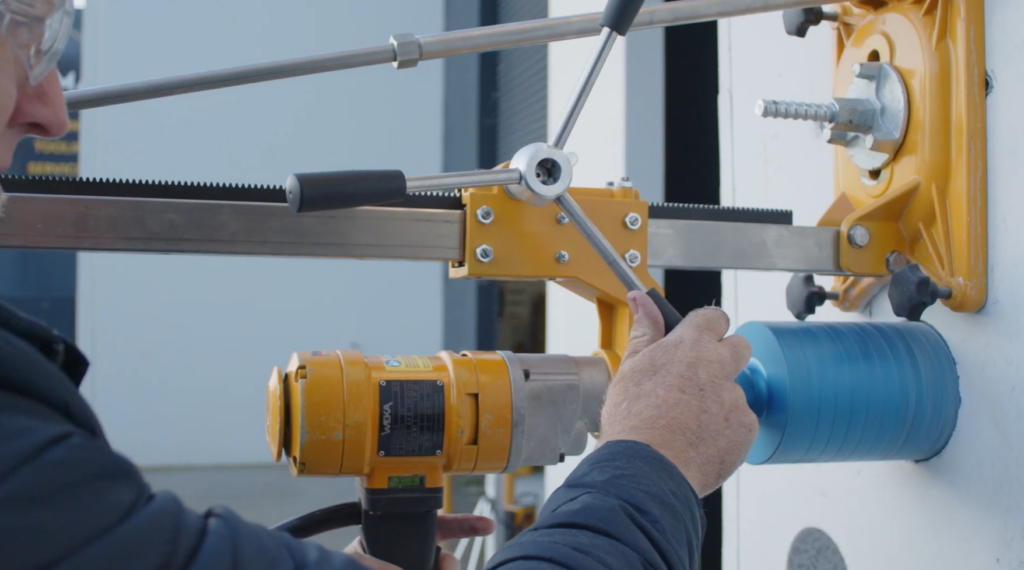
Choosing the right core drill is not simply a matter of buying the machine with the most power or the largest advertised drilling capacity.
Hole diameter, material, handheld or rig-mounted operation, available power and whether you need to drill wet or dry can all change the answer. For contractors comparing WEKA machines, the best place to start is the work you actually do.
The Quick Answer: Which WEKA Core Drill Do I Need?
- Under 100 mm, handheld and mobile work → BL20 or DK1603
- 100–350 mm → DK32 on a KS30E stand. Choose the DKS32 if you also need dry capability
- 350–400 mm on single phase → SR38
- 400–500 mm → DK52 on a KS50
- Above 500 mm → SR75 on a KS50XL, with BA50 auto feed for repetitive production work
- Dry drilling in masonry → DKS15
- Overhead or inverted work → check the IP rating and WEKA requirements for the individual machine before choosing the setup
The machine is only part of the system. Core bit diameter, gear selection, feed force and the correct diamond bond still determine how well the setup performs.
For a broader introduction to what these machines can do, Taman’s guide to unlocking the potential of core drills provides useful background before comparing individual machines.
Which Core Drill Do I Need for My Trade?
Electricians
Cable and conduit penetrations commonly sit around 25–100 mm, often in ceiling spaces or other areas where mobility matters.
The DK1603 covers wet drilling from 20–160 mm depending on the application and setup. Where water cannot be used and the substrate is suitable masonry, the DKS15 provides a dedicated dry-drilling option with soft impact.
Plumbers and Hydraulics
Pipe penetrations through slabs and block frequently fall between 50 and 160 mm.
The DK1603 is our most common handheld sale for this type of work. Contractors drilling regularly may instead consider the BL20, which adds a fourth gear, brushless motor and active kickback stop.
HVAC and Mechanical Services
Duct and pipe openings around 150–350 mm generally move the job into rig-mounted territory.
The DK32 on a KS30E is a practical combination for this diameter range. Where both wet and dry operation is required, the DKS32 offers another option.
Concrete Cutting and Coring Contractors
Dedicated coring contractors need diameter range as much as motor power.
The SR38 covers 40–400 mm through 18 speed steps while operating from 230 V. That range is particularly useful when hole sizes change significantly from job to job.
For larger production drilling, the DK52 extends to 500 mm, while the SR75 covers applications through to 900 mm.
Demolition, Structural and Civil Work
Large structural penetrations introduce higher power requirements, larger stands and often three-phase supply.
The SR75 sits at the top end of Taman’s WEKA drilling range and can be paired with the BA50 automatic feed for repetitive large-diameter work.
Testing and Inspection
Core samples for strength testing commonly sit around 75–150 mm.
Depending on access and drilling requirements, suitable options may include the DK1603, BL20 or HD1603.
Choosing a Core Drill by Hole Size
Diameter | Handheld option | Rig-mounted option | Typical stand |
15–100 mm | DK1603, BL20 | DK1603, BL20, HD1803 | KS18L |
100–160 mm | DK1603 / BL20 depending on material | DK1603, HD1803 | KS18L |
160–250 mm | Rig recommended | DK32S, DKS32, SR38 | KS30E / KS50 |
250–350 mm | Rig recommended | DK32, DKS32, SR38 | KS30E / KS50 |
350–400 mm | Rig only | SR38 | KS50 |
400–500 mm | Rig only | DK52 | KS50 |
500–900 mm | Rig only | SR75 | KS50XL + BA50 |
The important point is that headline drilling capacity is not necessarily handheld drilling capacity.
For example:
Machine | Rig-mounted concrete | Handheld concrete | Handheld masonry |
DK1603 | 20–160 mm | 20–100 mm | 20–160 mm |
BL20 | 16–182 mm | 16–100 mm | 16–200 mm |
A DK1603 can therefore be a 160 mm machine on a stand while remaining a 100 mm machine for handheld concrete drilling.
Three Questions That Can Change the Answer
1. Are You Drilling Overhead or Inverted?
Overhead wet drilling introduces machine-protection and water-management requirements that do not apply in the same way to normal horizontal or downward drilling.
Machines such as the HD1803, SR38, DK52 and SR75 use IP55-rated designs for demanding applications. Always check the specific WEKA operating requirements for the individual machine and drilling direction before setting up.
If overhead work forms a regular part of your jobs, this should influence the machine purchase from the beginning.
2. Do You Have Three-Phase Power?
Power supply quickly narrows the range at larger diameters.
The SR38 provides drilling up to 400 mm from a 230 V supply. Above that, the larger machines move into 400 V three-phase territory.
High-frequency equipment also needs to be considered as a complete system. The HD1803 requires a suitable frequency converter, so the converter needs to be included when comparing setup cost.
If you regularly work from portable power, the generator and its voltage regulation also become part of the core-drill buying decision.
3. Are You Wet Drilling or Dry Drilling?
Wet drilling is the normal approach for concrete and reinforced concrete because water cools the segments, clears swarf and helps manage dust.
Dry drilling is useful where water cannot practically be introduced and the material is suitable. The DKS15 covers handheld dry masonry drilling, while the DKS32 provides rig-mounted wet-and-dry capability with soft impact.
Decide whether you need wet, dry or both before buying rather than assuming every machine can handle both methods. Where dry drilling is required, the extraction setup also needs to suit the dust being produced. Taman’s dust extraction range includes equipment for concrete and construction dust management.
The WEKA Range Stocked by Taman
Taman’s handheld core drill range covers the smaller and more mobile end of core drilling:
Machine | Power | Ø range | Notes |
DK1603 | 2000 W, 3 gears | 20–160 mm | Wet. Hand or stand |
BL20 | 2200 W brushless, 4 gears | 16–200 mm | Kickback stop, broader speed range |
DKS15 | 2000 W, 2 gears | 30–180 mm | Dry, soft impact, masonry only |
The rig-mounted core drill range extends from smaller high-frequency drilling through to large production holes:
Machine | Power | Ø range | Notes |
DK32 | 3200 W, 230 V | 55–350 mm | 3 gears |
DK32S | 3200 W, 230 V | 35–250 mm | Higher-speed version |
DKS32 | 3200 W, 230 V | 52–350 mm | Wet and dry, soft impact |
HD1803 | 3700 W high frequency | 20–150 mm | IP55, requires converter |
SR38 | 3700 W, 230 V | 40–400 mm | 18 speed steps |
DK52 | 5200 W, 400 V | 110–500 mm | Three phase |
SR75 | 7500 W, 400 V | 150–900 mm | 15 speed steps |
Why Gear Range Matters
The DK32 and SR38 demonstrate why wattage alone is not enough to compare core drills.
They are within roughly 500 W of each other, but the DK32 uses three gears across 55–350 mm while the SR38 uses 18 speed steps across 40–400 mm.
If your jobs repeatedly use similar diameters, three gears may be entirely practical. If the hole size changes constantly, a wider speed range becomes much more useful.
That is why the machine needs to be chosen around the actual diameter range, not just the motor rating. If you want to understand the technical reason those speed ranges matter, see our guide to core drilling RPM, feed force and stand setup.
Before You Buy: Core Drill Checklist
Ask:
- What diameter do I drill most often?
- What is my largest regular hole?
- Am I drilling concrete, reinforced concrete or masonry?
- Do I need handheld or rig-mounted operation?
- Wet, dry or both?
- Is 230 V available, or do I have three-phase?
- Will I use a generator?
- Do I need high-frequency equipment?
- Will I drill overhead or inverted?
- Which stand suits my motor and maximum diameter?
- Does the machine’s speed range suit the bits I use?
- Who will service the machine and supply parts?
Taman is the Australian distributor for WEKA core drills and supplies motors, stands, tooling and supporting equipment, with in-house servicing and spare parts support for the equipment it sells.
If you already know roughly what you need, explore Taman’s core drilling machines, view the available core drilling packages or talk to the Taman team about sizing the complete setup.